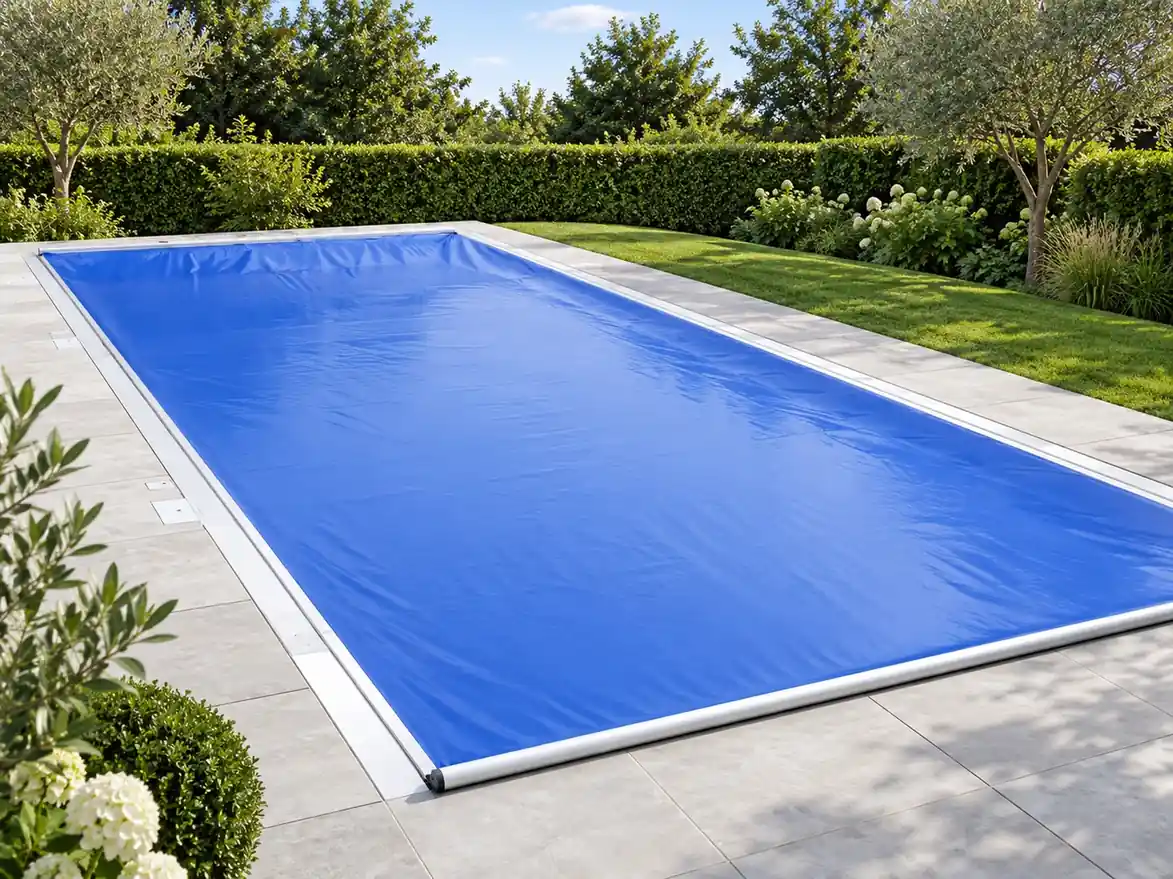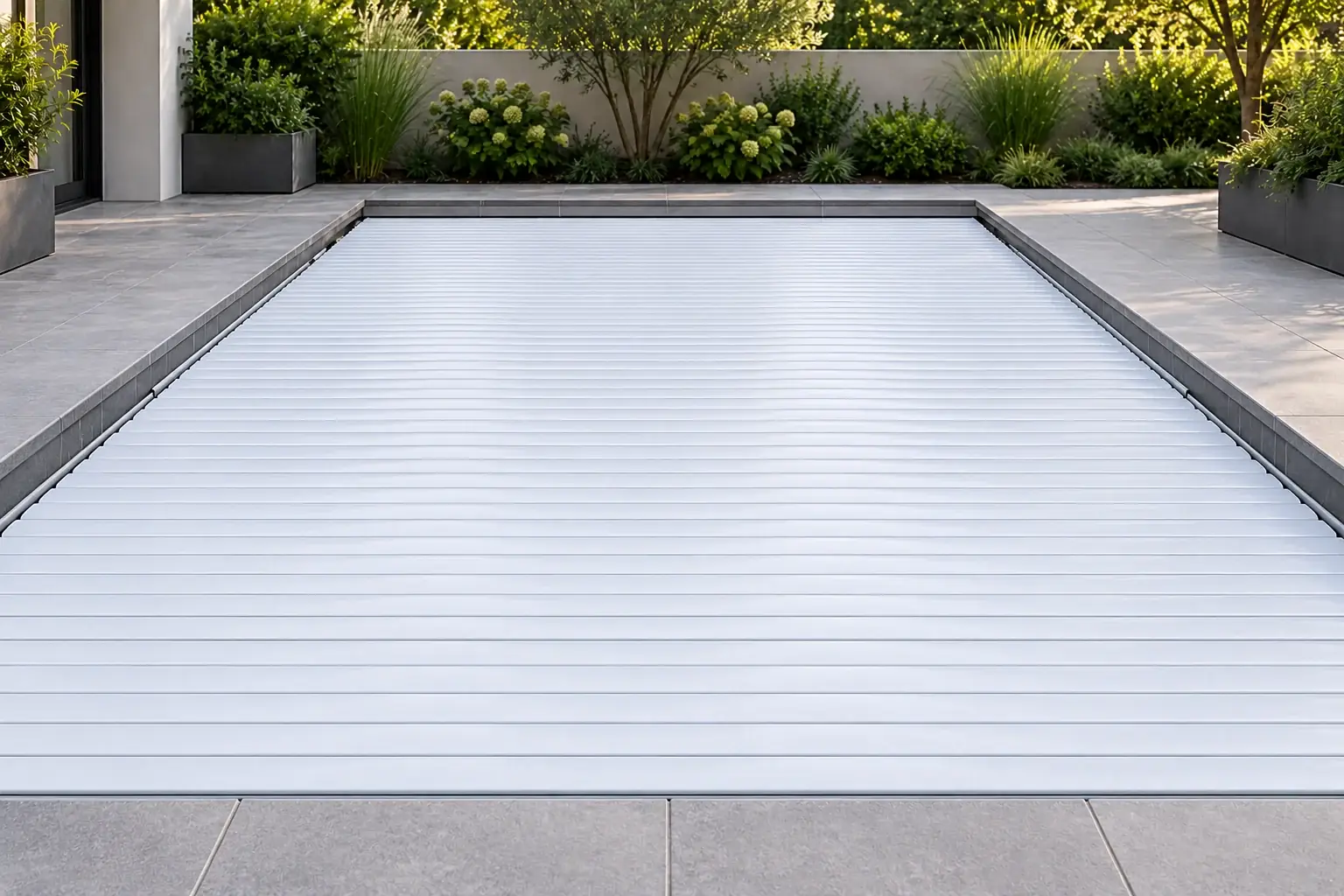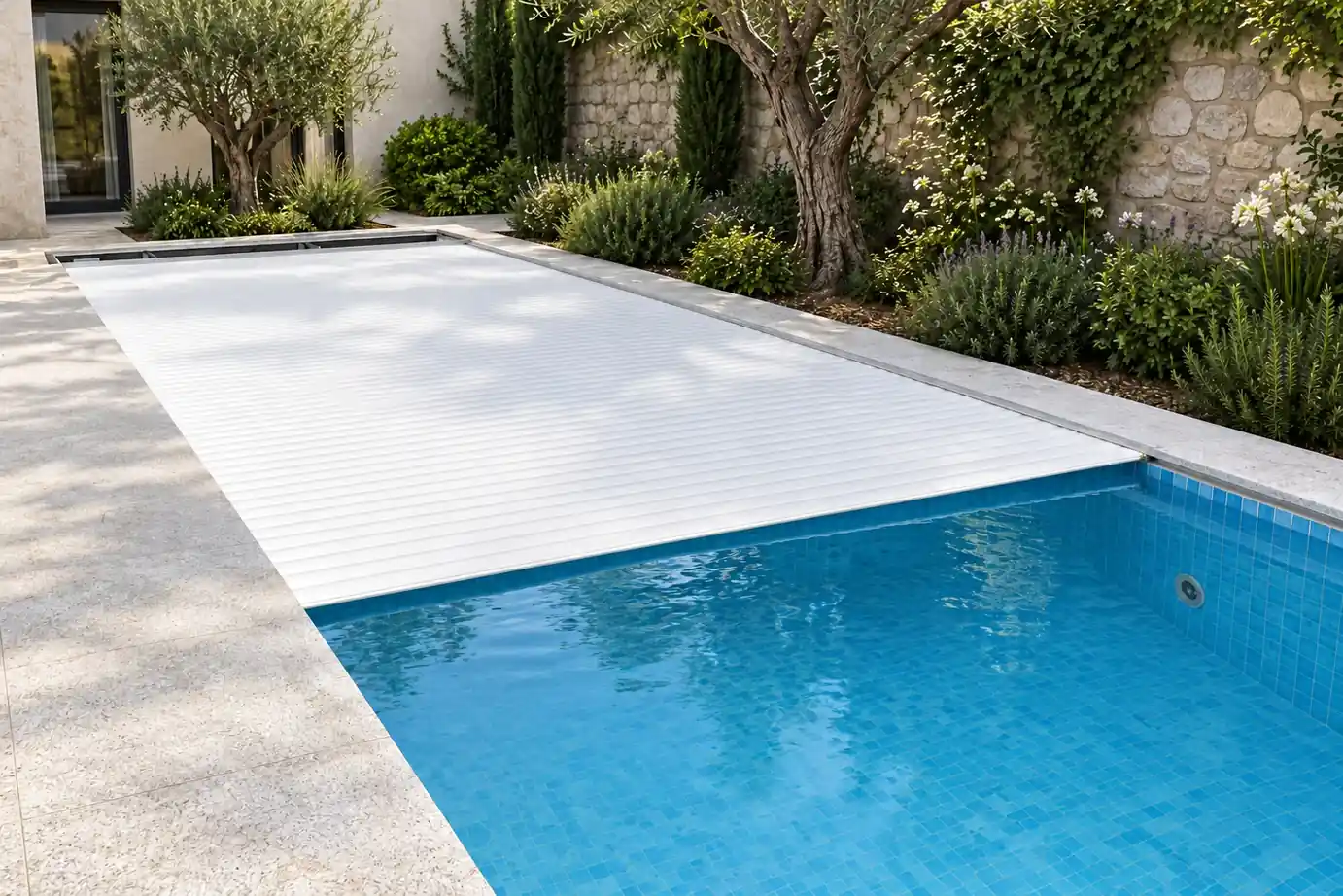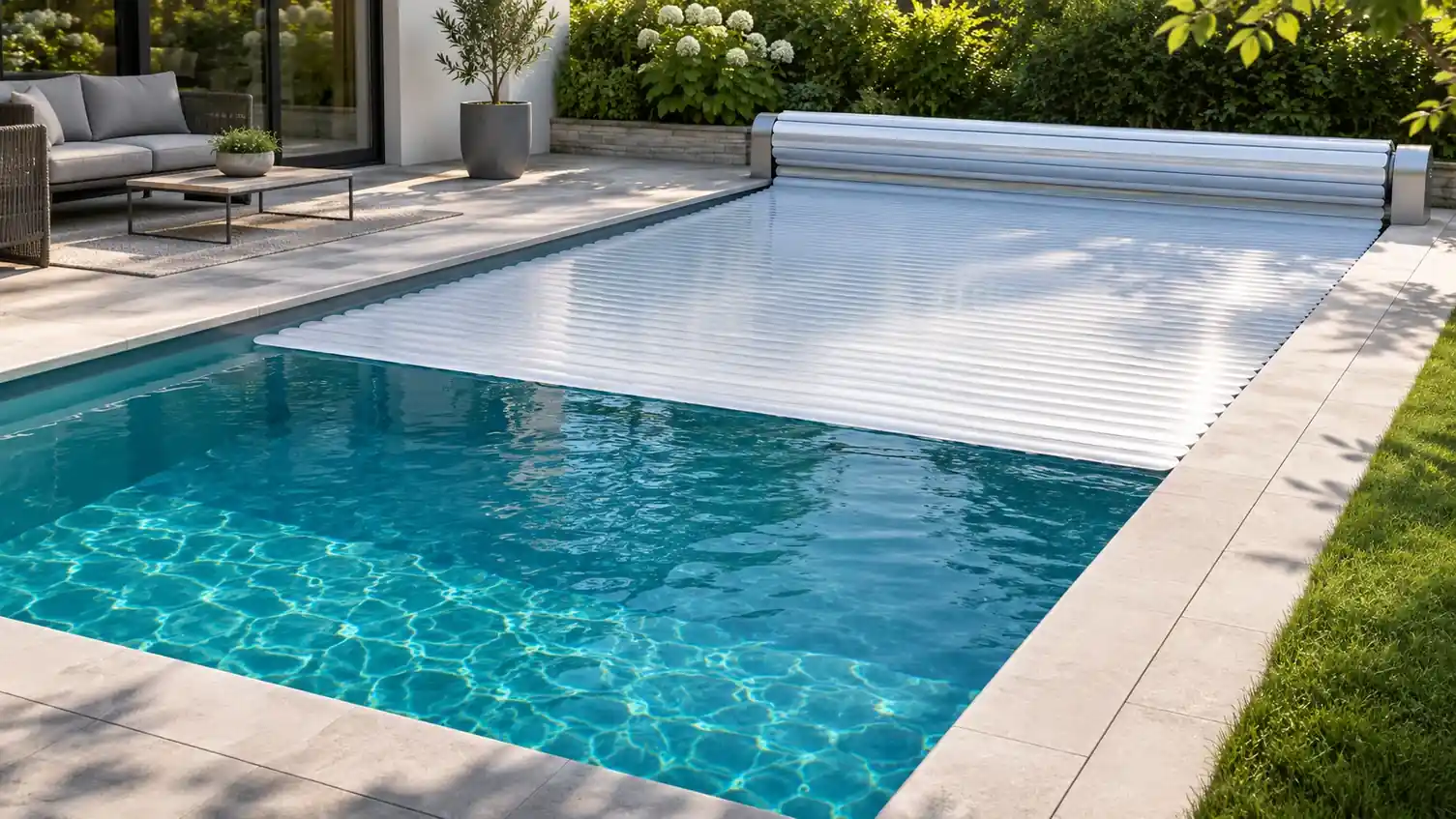
To start a pool cover inquiry, draw a simple sketch. Add the pool measurements and take clear photos. You do not need a finished engineering drawing for the first conversation.
These initial pool measurements help with an early suitability review and preliminary quotation. They are not automatically approved manufacturing dimensions. The final method, responsibilities and production dimensions must be agreed for the actual product and order.
What to prepare before you measure
Use a reliable tape measure, paper or a digital sketch, and a camera. Record feet and inches or metres and centimetres consistently, including fractions or decimals. Mark where each measurement begins and ends. Note the project location or delivery destination, whether the pool exists or is being built, the intended use and preferred cover type, if known.
First quote checklist
- Approximate length and width, with units and measurement reference points.
- A plan showing pool shape, steps and fixed obstacles.
- Overview photographs from both ends and close views of relevant edges.
- Approximate clear space for a roller, tracks or a parked deck.
- Delivery city or postal code, project stage, quantity and your role.
If you are unsure which system is appropriate, describe the problem and available space. Our pool cover comparison guide can help you prepare a shortlist.
How to measure a rectangular pool
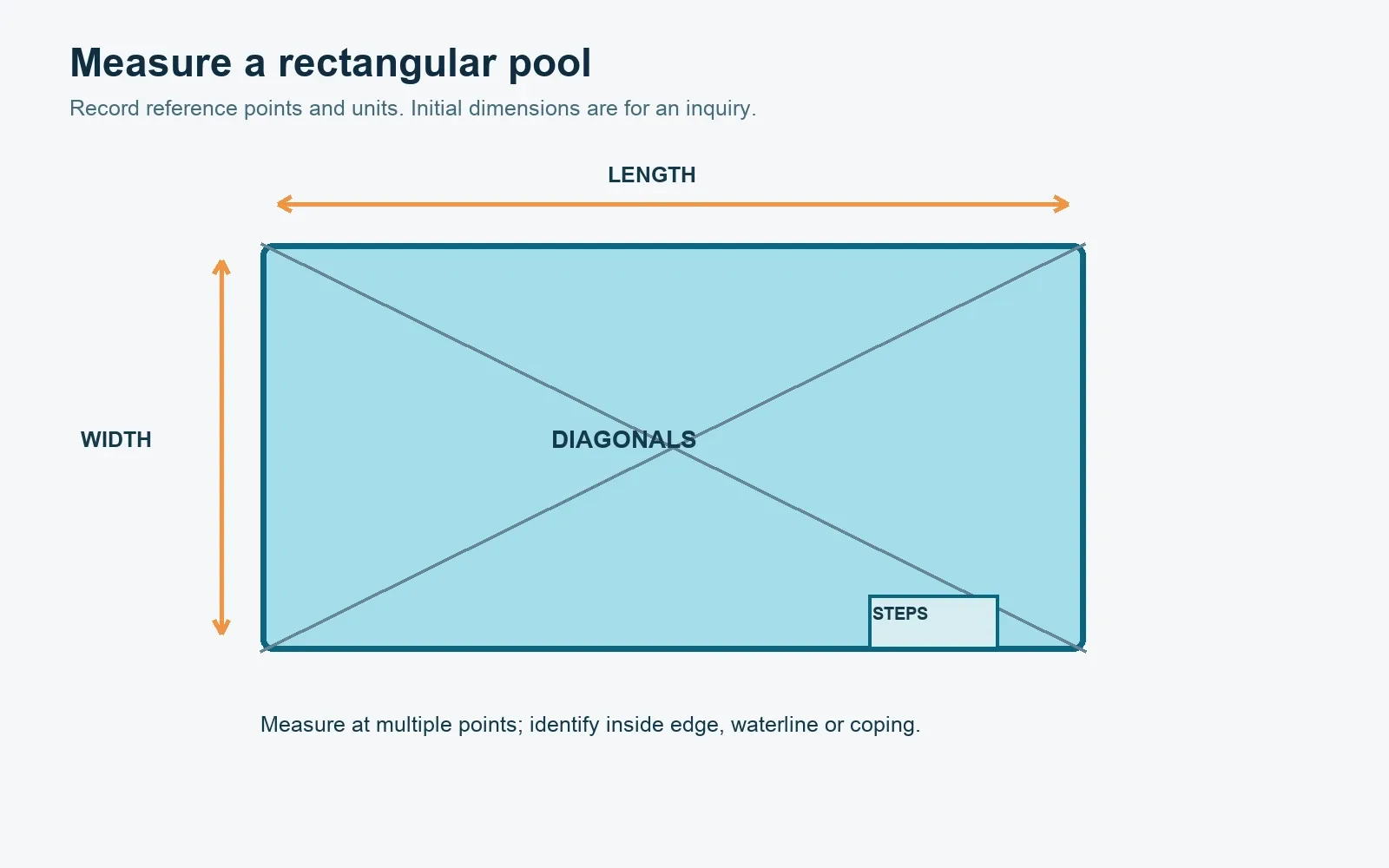
Initial dimensions are for an inquiry; confirm reference points with the supplier.
- Draw a simple plan and label the ends and sides so that your measurements match your photographs.
- Measure the length and width between clearly identified points. State whether these refer to the inside pool edge, water opening or another feature. Do not mix reference points.
- Measure at more than one position and record differences. Do not average away an inconsistency without telling the supplier.
- Measure both diagonals from corresponding corners. Different diagonal lengths can flag a shape or measurement issue that needs checking; they do not by themselves establish why the difference exists.
- Draw steps, rounded corners, recesses and projections separately. Record their positions and approximate dimensions.
- Photograph the entire opening, edge details and surrounding deck. Mark the likely operating direction if you have one.
For inground pool measurements, record the edge and surrounding structure separately from the water opening. A rectangle pool cover may require additional dimensions specific to its mounting system. Do not add a universal overlap or manufacturing allowance yourself unless the supplier instructs you to do so.
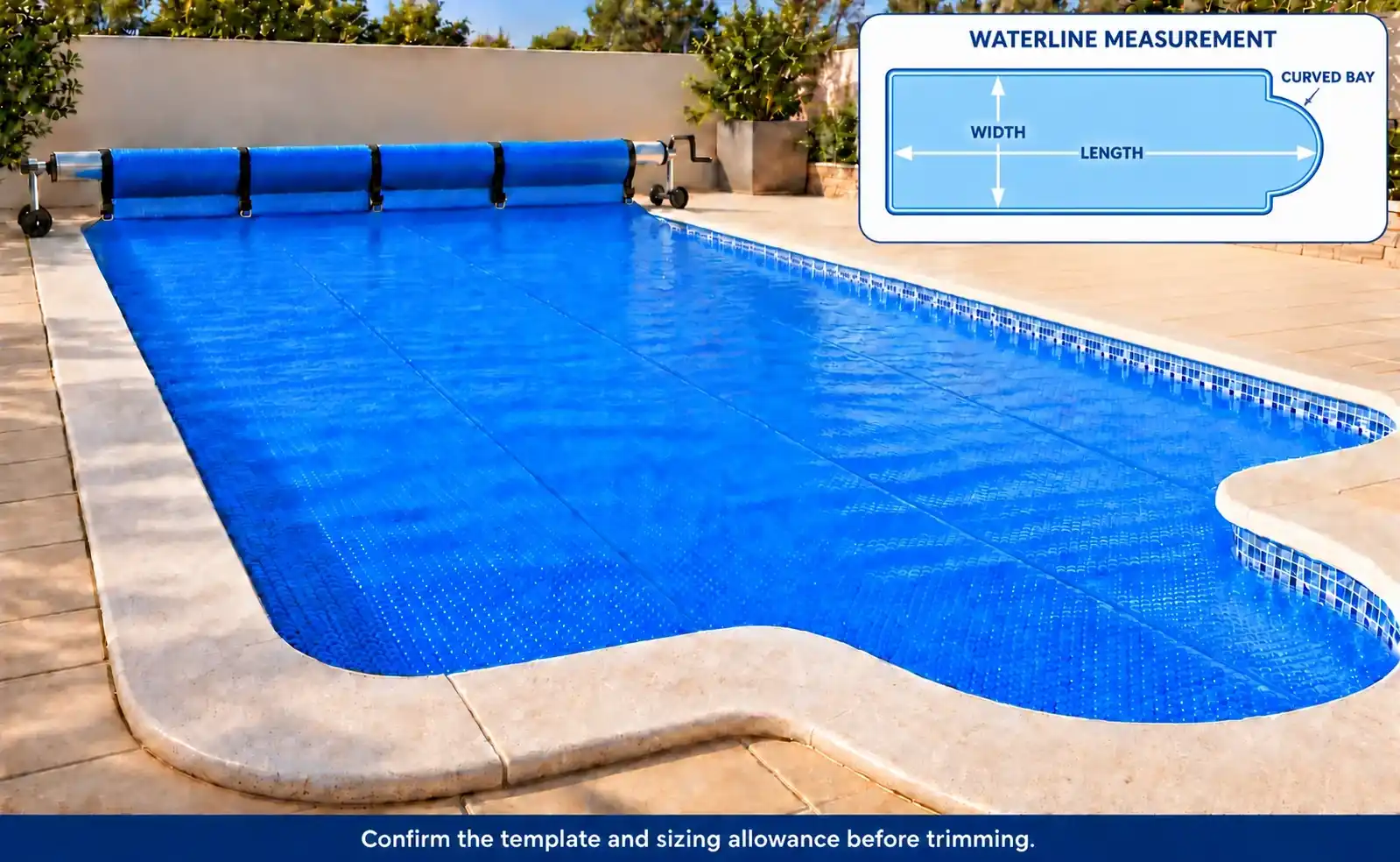
How to measure a freeform pool for a custom pool cover
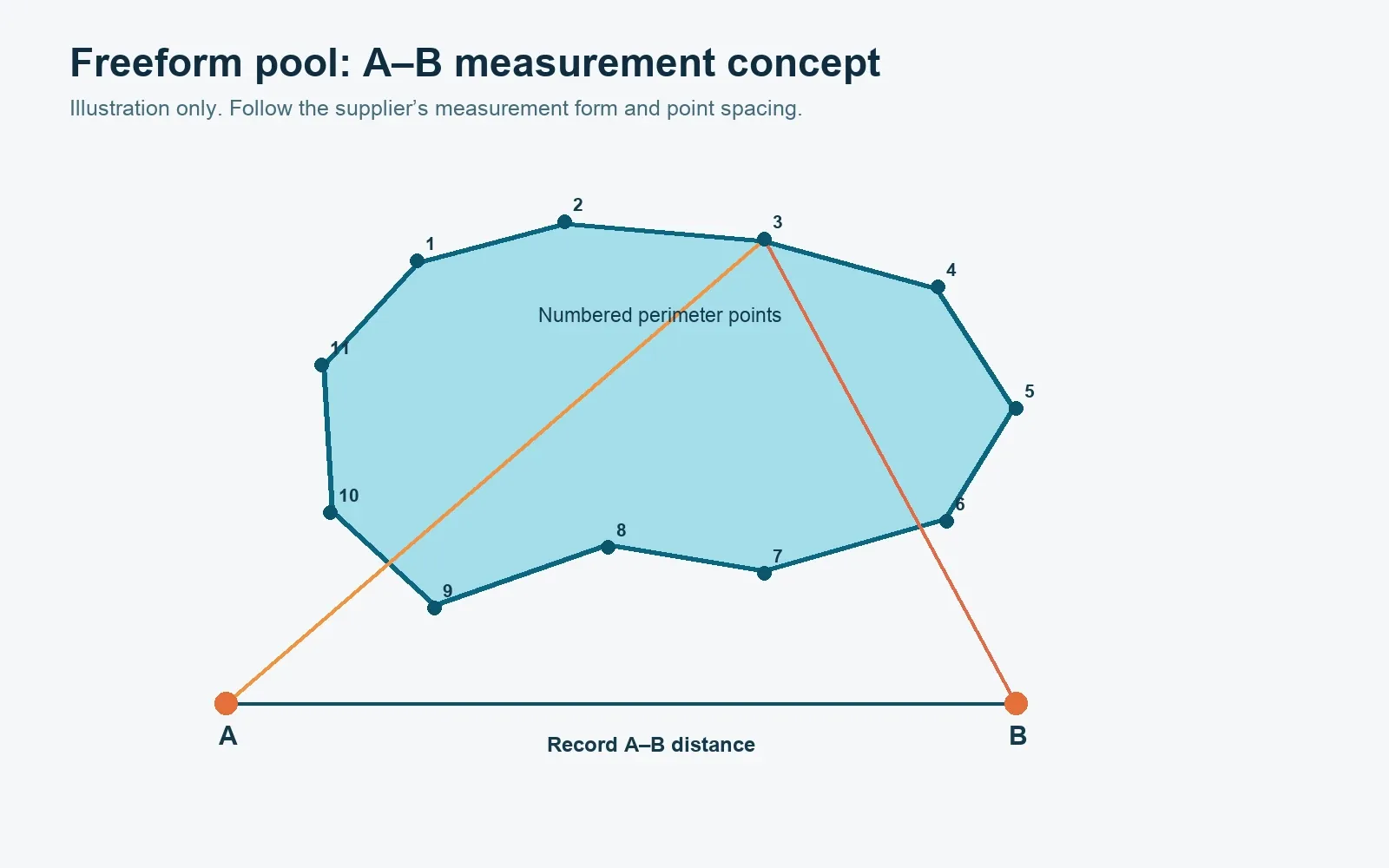
Illustration only; follow the supplier’s form and instructions.
A irregularly shaped pool may have the same maximum length and width as another pool while having a completely different outline. Begin with a sketch of the shape, then add the location of steps, curves and obstacles. Take photographs that match your labelled plan.
For some custom pool covers, suppliers use an A and B measurement method. Two fixed reference points, A and B, are established and the distances from both points to numbered points around the pool are recorded. The A and B distance and the numbering must also be recorded. Follow the supplier’s instructions for point spacing, reference point placement and any anchor measurements. This safety cover measuring form illustrates one supplier’s method; it is not a universal form for every cover.
Ask the supplier whether your irregularly shaped swimming pool needs A and B measurements, a template, a survey or another method. A slatted, sliding or fabric system can have different requirements. Never send a rough tracing as a production template unless the supplier has explicitly accepted that method.
Mark steps, obstacles and pool edges
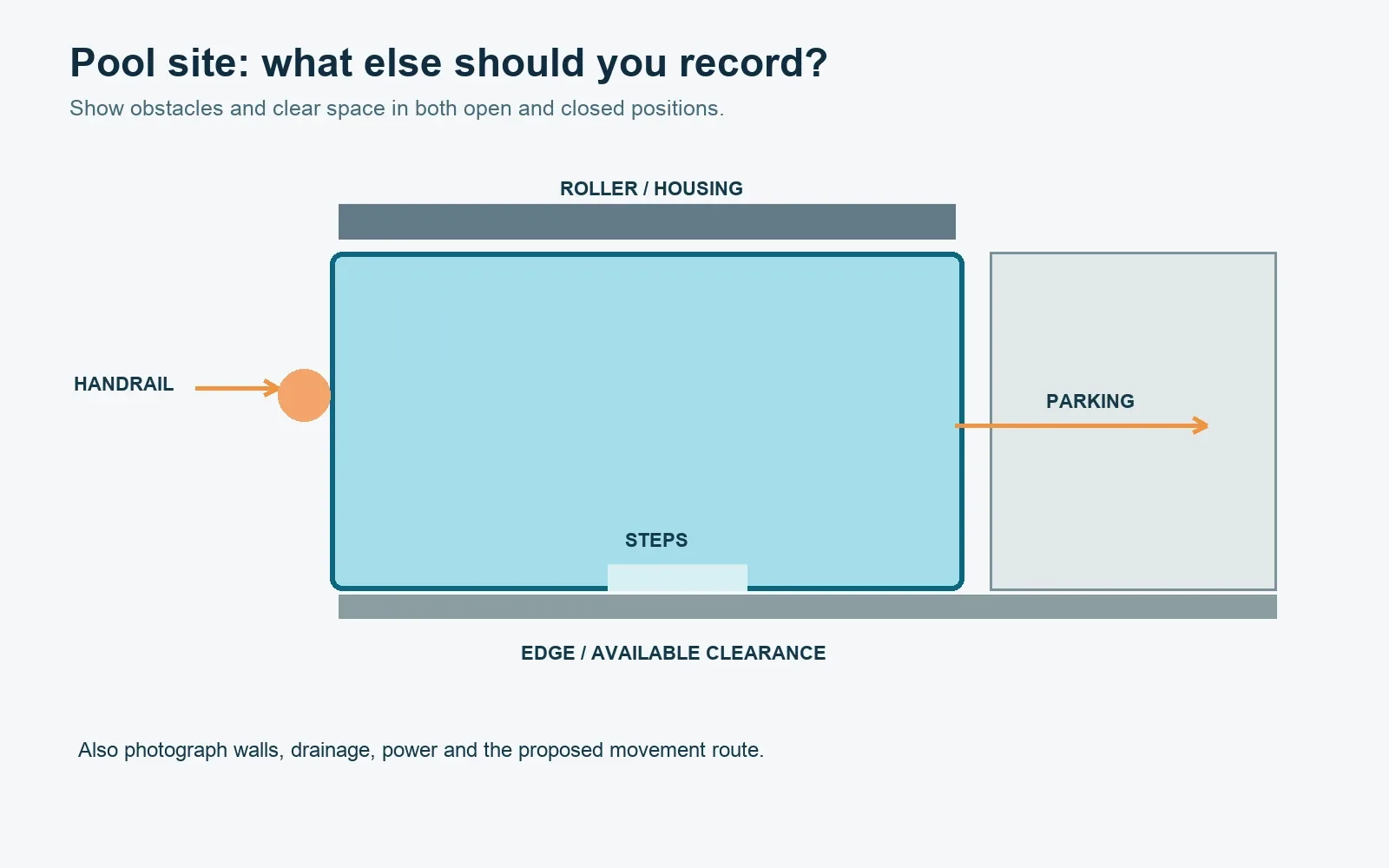
Record actual obstacles and clearances for your site.
An obstruction can change both the cover outline and the available fixing or operating space. On the sketch, mark and photograph:
- Steps, ladders, handrails, diving boards and raised features.
- Waterfalls, overflow edges, connected spas, pipes and equipment.
- Walls, fences, trees, rocks and other fixed objects beside the pool.
- Edge material, height changes, slopes, drainage and possible fixing areas.
Give each important feature a label and a measurement from an identified point. For an existing cover replacement, mention existing tracks or anchors, but do not assume a new cover will reuse them without verification. A photograph reveals context; it does not establish scale or hidden construction.
What else should you measure for each cover type?
Swipe or scroll to see the full table →
| Cover type | Information to add to your first inquiry |
|---|---|
| Automatic pool cover or retractable pool cover | Proposed opening direction, potential track route, roller or housing location, access and available power location |
| Mesh pool cover or other safety system | Perimeter surface and potential fixing area, steps, handrails and other interruptions; ask for the specific to the model measuring form |
| Polycarbonate pool cover or slatted system | Proposed roller position, surrounding clearance, water level information and features that may interrupt the slats |
| Bubble or foam cover | Water surface outline, handling route and space for a pool cover roller if required |
| Sliding deck pool cover | Direction of travel, full movement path, parking area, ground levels, drainage and possible foundation constraints |
These are starting points, not a final installation design. Ask which additional dimensions and drawings are needed for the system you are considering.
Pool sizes and standard dimensions: why your measurements matter
Typical pool dimensions can help estimate a project, but a standard pool size is not a substitute for measuring the actual opening and site. Two inground pool dimensions that look identical on a plan may hide different step pockets, edge heights or space for a roller. Above ground pool dimensions also need to account for wall construction and the proposed fixing method.
If the pool is not built yet, send the latest drawings and identify which dimensions are planned. The supplier and installer should determine what must be rechecked after construction before production is approved.
From preliminary measurements to production approval
A practical sequence is:
- Initial inquiry: send approximate pool dimensions, photos, location and your goals.
- Preliminary review: discuss suitable cover families, site constraints and an indicative configuration or quotation.
- Detailed measurement: obtain the supplier’s specific to the product instructions and agree who will measure and review the site.
- Final confirmation: check the drawings, dimensions, components, colour and other order details with the relevant parties before production proceeds.
Clarify in the quotation or contract who measures, who checks the drawings and how errors or changes are handled. Do not assume that the person supplying an estimate is automatically responsible for every later measurement.
How to measure a pool: a worked example for a first quote
Imagine an existing rectangular pool with a handrail at one end and a wall beside the other. Measure the water opening at several points and write each reading on a labelled sketch. Record both diagonals from matching corners.
Then measure the clear space between the proposed roller position and the wall, and photograph the handrail and pool edge. Mark any measurement that is approximate. This package can help the supplier ask better questions; it does not establish that a particular system will fit.
When you explain how to measure a pool to a contractor or owner, agree on the reference points first. If one person measures from the inside edge and another measures from the outside coping, the numbers can differ even when both readings are accurate. Send the individual readings, not just an average, and label the unit on the drawing and in the message.
How to measure a pool: common mistakes that delay a quotation
Swipe or scroll to see the full table →
| Mistake | Why it matters | Better first step |
|---|---|---|
| Sending only the maximum length and width | Steps, curves and obstructions may change the solution | Add a labelled sketch and photographs |
| Measuring the pool but not the operating area | A roller or sliding deck may not fit beside it | Show the proposed position and available clearance |
| Leaving off units or reference points | The supplier cannot reliably interpret the figures | Label every measurement and use one unit system |
| Treating an initial estimate as a production drawing | The actual product may require a different survey | Request the supplier's final measurement form |
| Assuming existing anchors or tracks can be reused | Spacing, condition and compatibility may differ | Photograph them and request a compatibility review |
If you need to know how to measure a pool for a cover but cannot reach a feature safely or identify its construction, note the uncertainty and ask the installer or supplier for the next step. Do not estimate a hidden foundation or electrical route as if it were verified.
A simple first quote message
“Existing inground pool in [city/country]; approximate inside opening [length × width and units]; [rectangular/irregularly shaped]; steps at [location]; photos and sketch attached; possible roller location [description]; intended use [daily/seasonal]; quantity [number]. Please advise suitable cover types and what additional measurements you require.”
For dealers and contractors, include the number of projects or kits, target delivery destination and whether a local installer is involved. A preliminary quote can then identify unknown site works, shipping and product configuration instead of presenting them as confirmed costs.
Frequently asked questions
Can photographs or drone images replace pool measurements?
No. They help explain shape and obstacles, but do not reliably establish dimensions, levels or construction details. Send photos with a labelled sketch and measurements.
How do I measure an above ground pool for a cover?
Record the pool shape and dimensions using identified reference points, then photograph the walls, rim, access ladder and surrounding area. Ask the cover supplier which additional wall and fixing dimensions are needed.
Should I use feet or metres?
Either is useful if you state the unit clearly and use it consistently. Confirm the supplier’s preferred format before submitting final production measurements.
Do I need to measure space for a pool cover roller?
Yes, if a roller is being considered. Show the proposed location, clear width and nearby obstructions, and ask the supplier what clearance and maintenance access the system needs.
Can I order a custom cover using standard pool dimensions?
Standard pool dimensions are useful for an initial discussion. A custom pool cover should be made using the final measurement method and approved dimensions agreed with the supplier.
Send your first project brief
Share your sketch, approximate dimensions, photographs, delivery destination and intended use with PoolCoverKits. Tell us whether you are a dealer, contractor or owner and whether the pool is new or existing. We can discuss suitable cover types and the additional information needed for a preliminary quotation.
Free Inquiry